How Confrontational Protest Shapes Public Opinion: Experimental Evidence from Climate Mobilization
Abstract
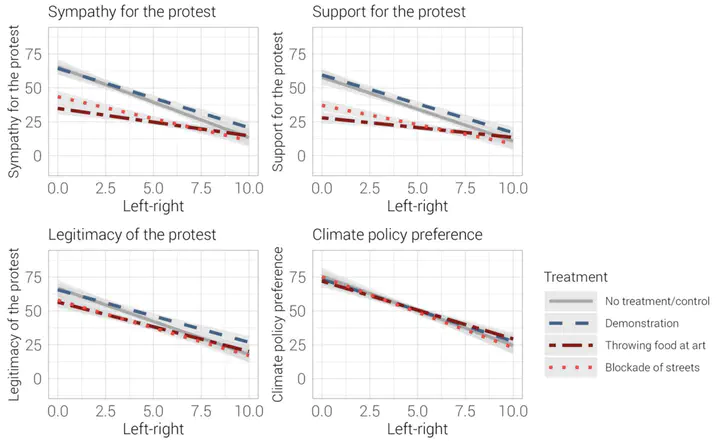
This study examines how different protest forms shape public opinion, distinguishing between support for protest tactics and policy goals. While protest is widely recognized as a legitimate mode of political participation, its forms vary in how they are perceived by the public. Drawing on two cross-sectional surveys and two survey experiments on climate protests in Germany, we focus on the distinction between demonstrative and confrontational protest forms. We find that demonstrative tactics are broadly perceived as legitimate. Being exposed to them leads to a stronger sympathy and more support for the movement compared to a control group. In contrast, confrontational tactics—such as blockades or symbolic art attacks—reduce these responses, particularly among left-leaning citizens, while leaving the already low support levels of right-leaning citizens unchanged. Crucially, we find null effects concerning policy support: the negative impact on attitudes toward protesters neither weakens nor strengthens support for their policy goals. Thus, confrontational protest may not substantively harm its broader political cause, at least in the short run. This finding contributes to the literature on social movement and protest effects by highlighting that loss of support for the movement does not automatically translate into changes in public support for the policy goals the movements advocate.

Lennart Schürmann
Max Weber Fellow · PRIME Fellow (PostDoc)
My research interests include · Political Behavior · Party Politics · Electoral Systems · Representative Democracy · European Politics